Resources

Everything You Need For Better Leaders & Smarter Strategies.

Free guides, a research-backed self-assessment, a library of complimentary articles, and a monthly newsletter — built on peer-reviewed behavioral science. Because the power of psychology should be accessible to everyone.

Flagship Tools

Start Here.

Two complimentary, research-grounded resources designed to meet you where you are — one for self-discovery, one for applied practice.

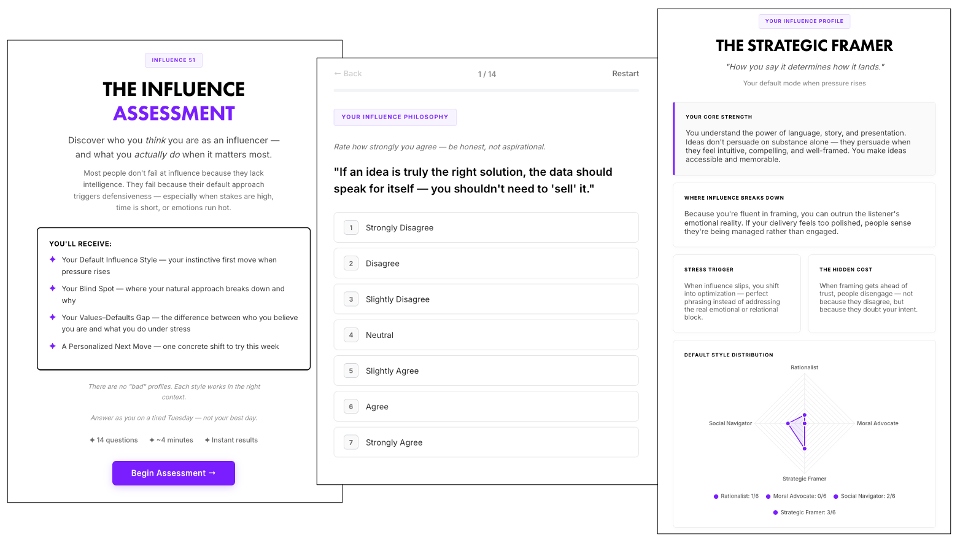
The Influence Assessment — cover, sample question, results profile
01 · Assessment

Discover Your Influence Style.

Most people don't fail at influence because they lack intelligence. They fail because their default approach triggers defensiveness — especially when stakes are high, time is short, or emotions run hot.

In about 4 minutes, surface your default influence style, your blind spot, the gap between who you believe you are and what you do under pressure, and one concrete move to try this week.
14 Questions ~4 Minutes Instant Results

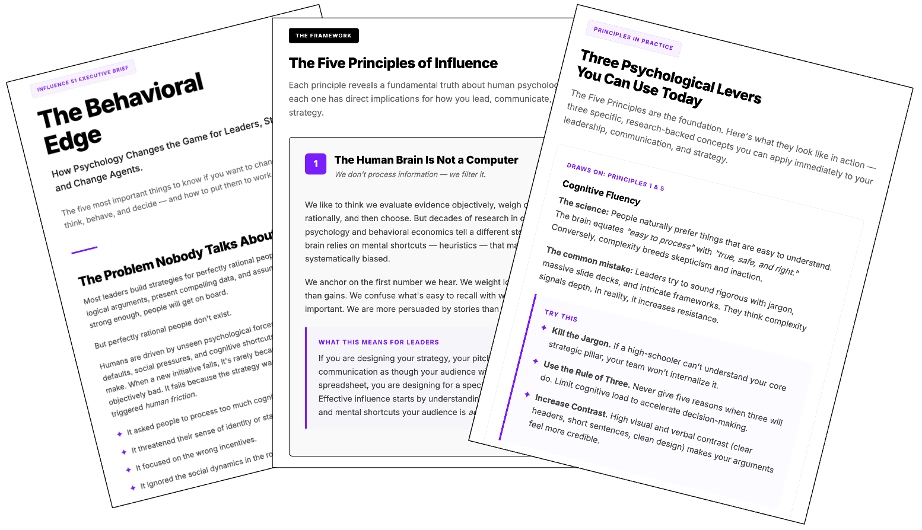
The Behavioral Edge — Influence 51 leader guide
02 · Leader Guide

The Behavioral Edge.

A compact executive brief on how psychology changes the game for leaders, strategists, and change agents.

Inside: the five most important things to know if you want to change how people think, behave, and decide — and how to put them to work tomorrow.

  • 01The Brain Isn't a Computer
  • 02Our Social Nature Matters
  • 03Political Sensibilities Matter
  • 04Our Approach Matters
  • 05Structure & Presentation Matter

12 Pages Executive Brief Free Download

Monthly Newsletter

The Influence 51
Newsletter.

Monthly insights into what moves people. Learn the psychology and behavioral science behind how people think, decide, and act — and practical ways to apply it the next day.

June 2026 Edition

The Calibrated Stumble.

In late April 1961, John F. Kennedy walked off the worst week of his young presidency — the Bay of Pigs invasion had collapsed in fewer than 72 hours — and watched his Gallup approval climb to 83%, the highest of his time in office.

That oddity has a name in social psychology: the pratfall effect. Done well, a small, well-placed stumble can humanize a high-status communicator and make them more — not less — persuasive. Done poorly, it just looks like incompetence.

This month's newsletter covers:

  • The 1966 College Quiz Bowl study that first isolated the effect — and why the result hinges entirely on the perceived competence of the person doing the stumbling.
  • Why the same small mistake helps one leader and quietly damages another — the contingencies around self-esteem, severity, and (per Brescoll & Uhlmann) gender that turn a pratfall into a pitfall.
  • A 2025 study of 350 B2B sales managers showing the calibrated stumble is a double-edged signal — and four imperatives for using it without cutting yourself.

Subscribe to read the rest — and receive next month's issue in your inbox.

Complimentary Articles

12 Essays On What Moves People.

Short, research-grounded reads on the mechanisms that drive persuasion, judgment, and behavior change.

What's Next

Bring This Work To Your Team.

Start with a complimentary discovery call — or learn more about how we work.